Back to Work

Custom Operations System

One controlled workflow from service request to operational closure.

Designed around an illustrative commercial maintenance operation, this working product connects triage, dispatch, Technician execution, exceptions, Client decisions and Finance handoff while preserving authority, ownership and audit history.

Concept-to-implementation case study

No real Client engagement or measured production outcome is claimed.
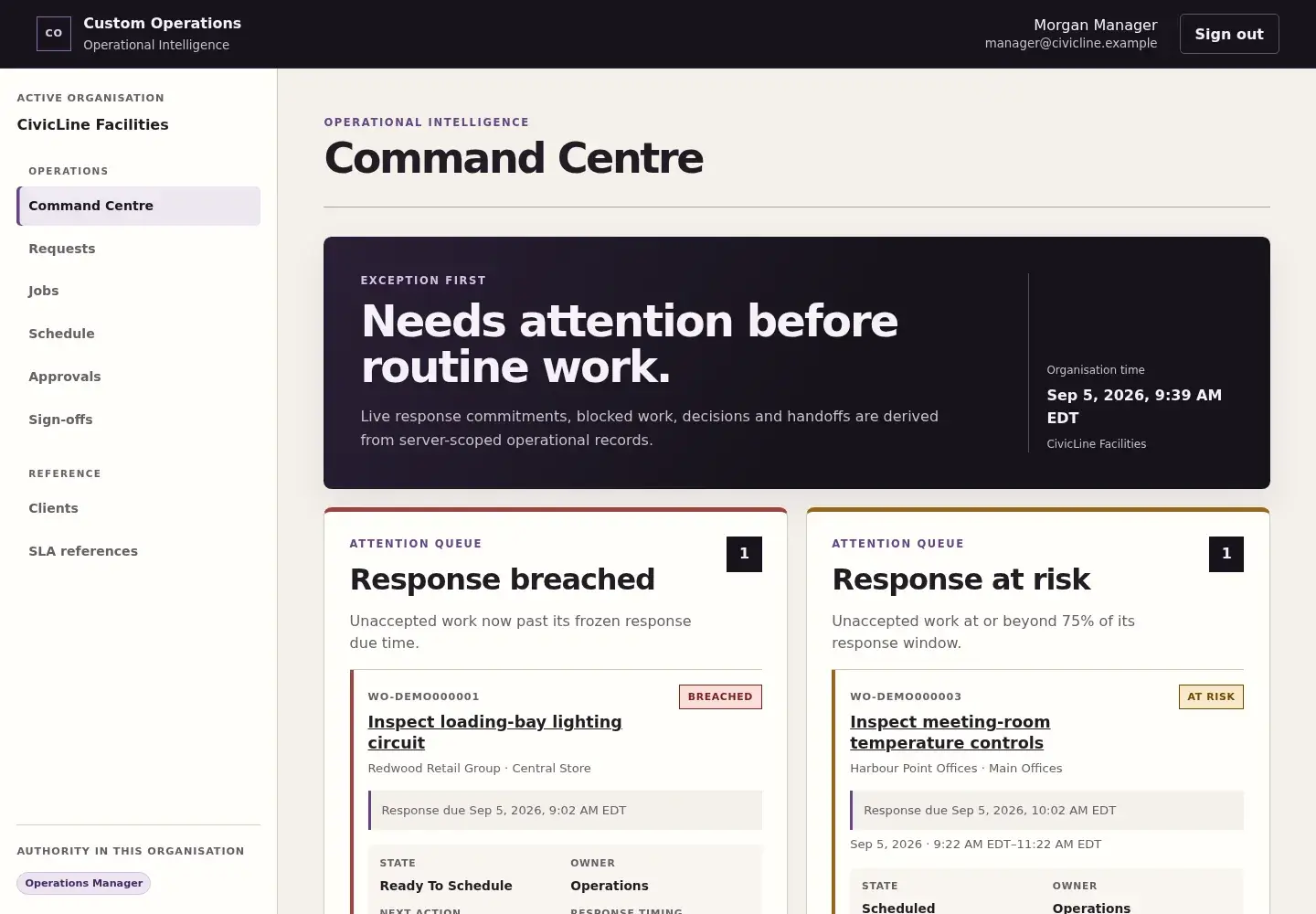
Custom Operations System Command Centre showing response commitments, blocked work, decisions, assignments and Finance handoffs
The implemented Command Centre derives attention from operational records. All organisations, people, sites and work shown are synthetic.

The business process comes before the dashboard.

The scenario begins with a common coordination problem: requests, schedules, field updates, evidence, approvals and handoffs distributed across separate tools. It is illustrative, not a claim about a real Client's operation.

A generic project tracker could store tasks, but it would not necessarily preserve the difference between incoming demand and accepted work, freeze the relevant service commitment, enforce assignment-level field access or model who owns an exception decision.

Custom software earns its place here by making those operational distinctions executable. The design objective is traceable ownership and controlled handoffs—not a prettier collection of cards.

Illustrative fragmented process

  1. 01Phone, email and messages
  2. 02Manual interpretation
  3. 03Spreadsheet and calendar
  4. 04Technician coordination
  5. 05Chat-based evidence
  6. 06Approval threads
  7. 07Separate Client and Finance follow-up

Implemented controlled workflow

  1. 01Service Request
  2. 02Controlled triage and conversion
  3. 03Work Order
  4. 04Schedule and Assignment
  5. 05Technician execution and Evidence
  6. 06Exception and explicit approval
  7. 07Client sign-off, Finance handoff and closure
The starting process is a clearly labelled scenario, not a measured Client baseline. The redesigned sequence is implemented product behaviour.
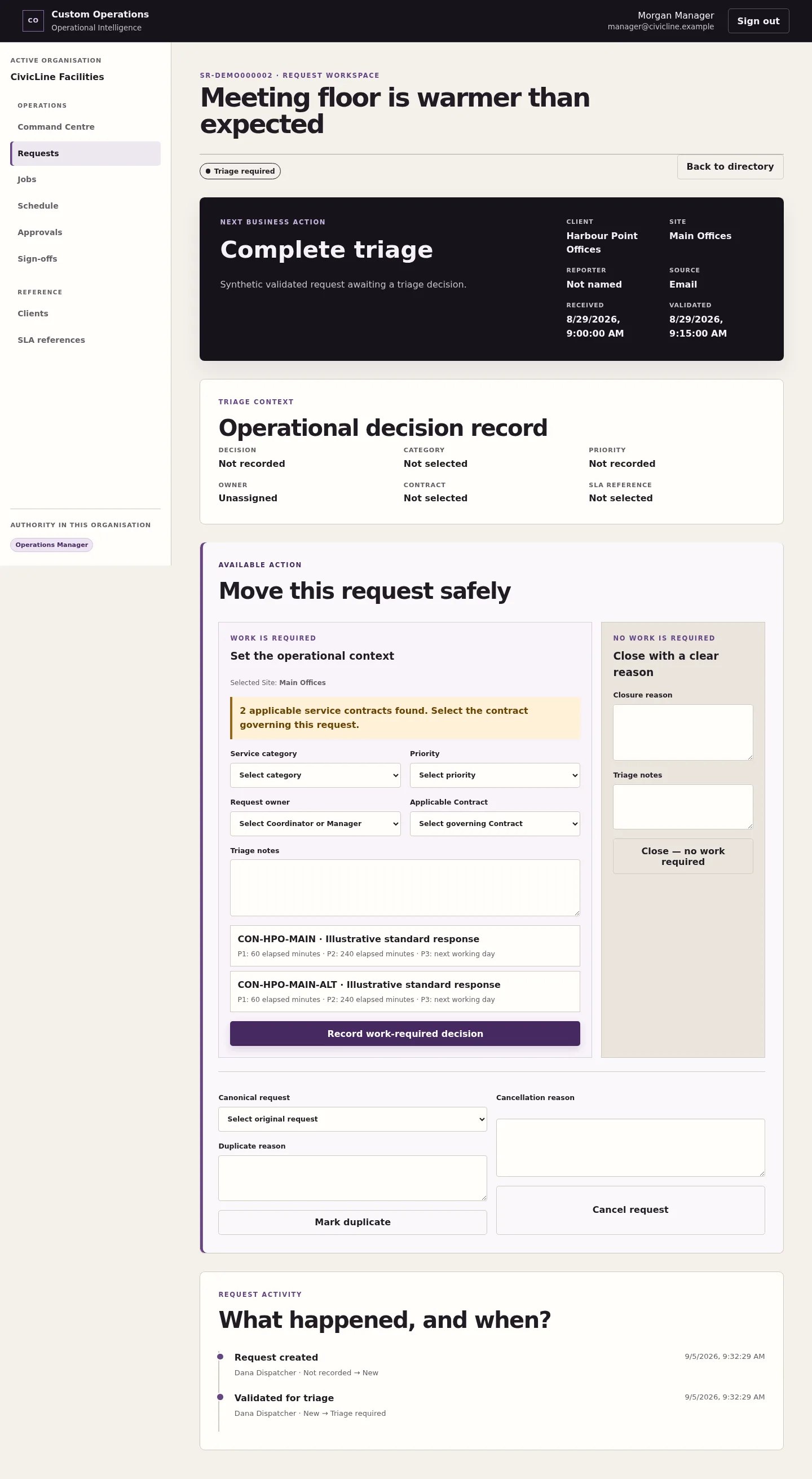
Service Request triage workspace with ownership, contract context, service commitment and controlled conversion actions
Intake and triageA Service Request can be clarified, identified as a duplicate, cancelled or closed without work. Work-required demand converts atomically into a separate Work Order.
Work Order workspace showing lifecycle, assignment, service context, evidence and operational history
Connected operational recordThe Work Order brings scheduling, field work, exceptions, completion and the audit trail into one controlled lifecycle without erasing their boundaries.

State, schedule and ownership are separate decisions.

The server governs lifecycle transitions. Scheduling records when work should happen; Assignment identifies the exact Technician who currently owns field execution.

Primary lifecycle
  1. 01Ready to schedule
  2. 02Scheduled
  3. 03Assigned
  4. 04Accepted
  5. 05In progress
  6. 06Completed
  7. 07Client sign-off
  8. 08Finance handoff
  9. 09Closed
Portfolio-native rendering of the supplied Work Order state-machine and approval semantics.
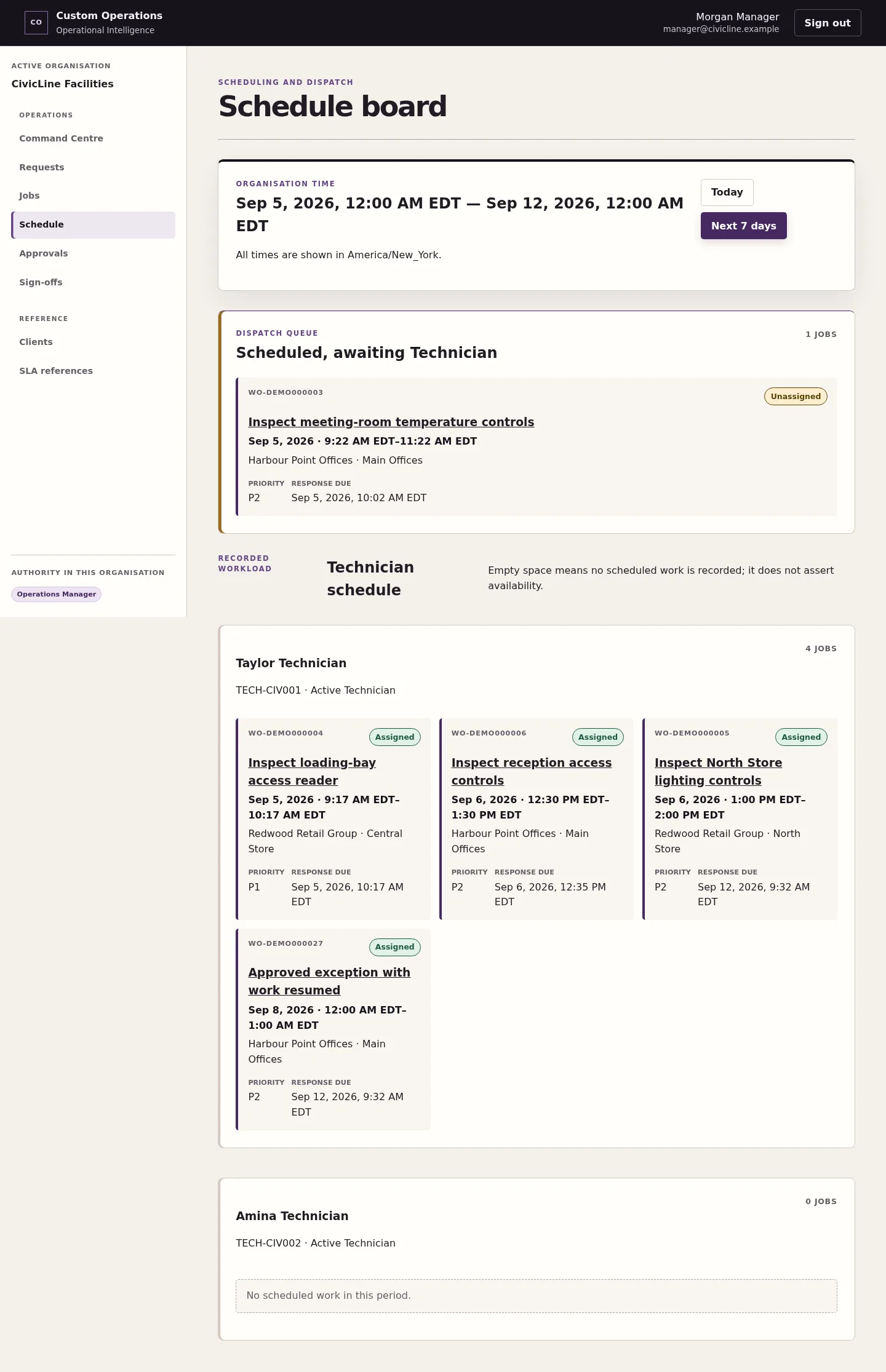
Schedule and dispatch workspace with recorded work windows, Technician assignment and conflict handling
Schedule and dispatchDispatch records schedule history, current Assignment and explicit conflict overrides. It does not claim GPS, route optimisation or inferred availability.
Mobile Technician workspace with accept, start, note, evidence, exception and completion actions
Assignment-scoped field workflowThe narrow interface is built around field commands. A Technician needs both the capability and the exact current Assignment; role membership alone cannot expose every job.

Exceptions become owned decisions, not comments in a thread.

Reporting an exception blocks work, creates a numbered approval attempt and identifies the decision owner. Approval and resumption remain separate commands so the audit history reflects what actually happened.
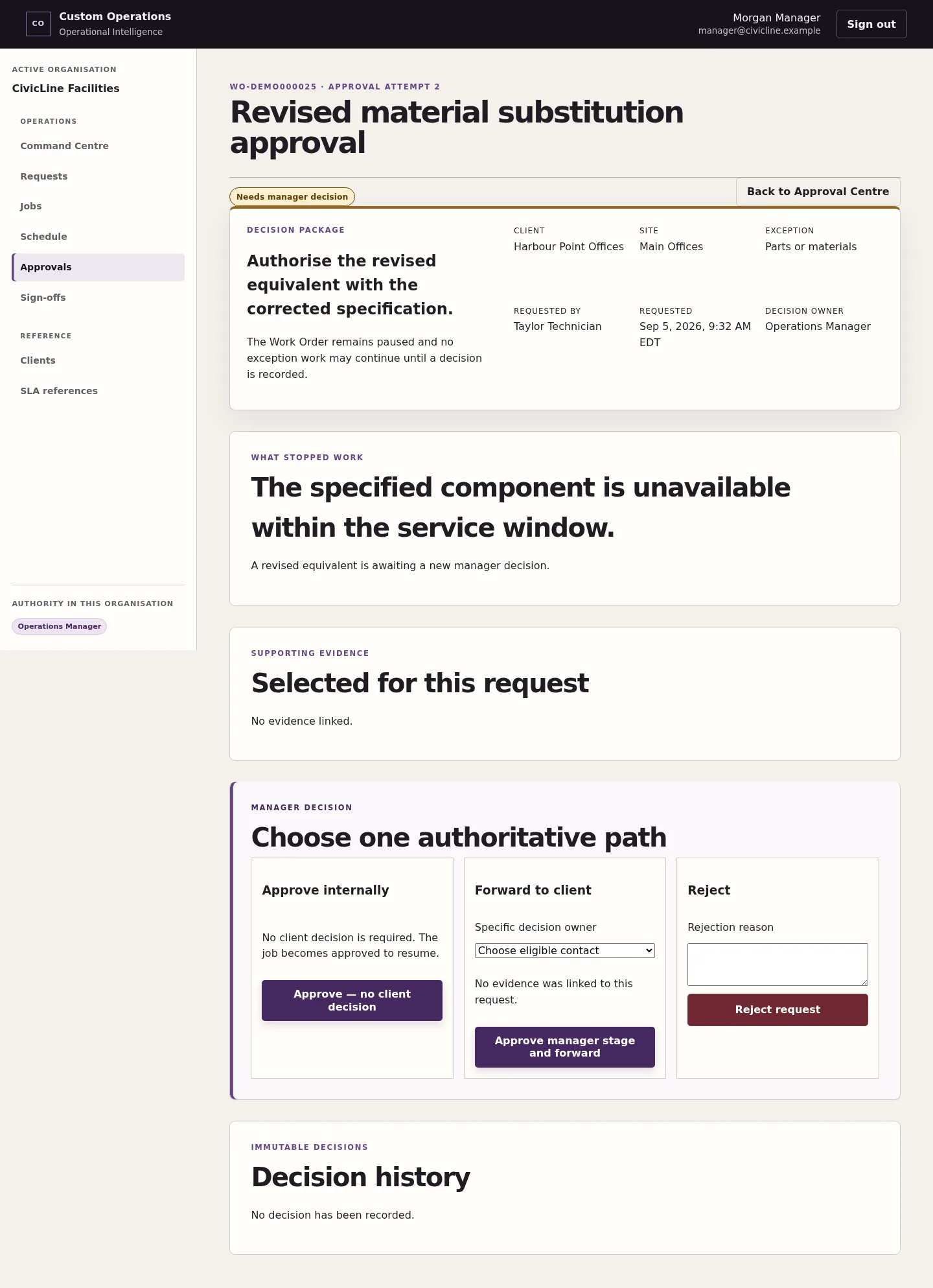

Internal approval detail showing exception context, decision owner, evidence and immutable attempt history
Controlled exception reviewInternal managers can see the operational context and attempt history needed for a bounded decision. A rejected attempt remains part of the record.
Mobile Client approval page exposing only the scoped decision and explicitly shared evidence
Client decision boundaryOnly the selected eligible Contact for the matching Client and Site can decide. The view exposes only evidence explicitly linked to this approval.
Authenticated identityActive organisation membershipCapabilityExact resource scope

Operations Coordinator

Triage, schedule, assign and coordinate

Field Technician

Act only on the exact current Assignment

Operations Manager

Decide authorised operational exceptions

Client Contact

View and decide only explicitly scoped records

Finance / Billing

Acknowledge accepted service handoffs

System Administrator

Administer the system without inherited operational authority

Better Auth establishes identity. The application separately resolves organisation, membership, capability and record scope; Administrator is not a universal operational superuser.
Role-specific interfaces

Operations / Technician / Client / Finance

Server command and policy boundary

Revalidate state / authorize scope / actor-bound idempotency / serializable transaction / activity event

Authoritative operational model

Next.js 16.3.3 / Prisma 7.10.0 / PostgreSQL 18

A simplified rendering of the supplied architecture and security trust models; it adds no queues, brokers or external infrastructure.

Completion stays distinct from Client acceptance and Finance.

Technician completion prepares a Client-safe sign-off package. Accepted sign-off creates a ready Finance handoff; Finance acknowledgement then closes the operational lifecycle without pretending to invoice or collect payment.

Mobile Client completion review with service summary, shared evidence and accept or reject controls
Client completion reviewThe Contact reviews a deliberately limited completion package. Acceptance and rejection are explicit business events, not a generic status edit.
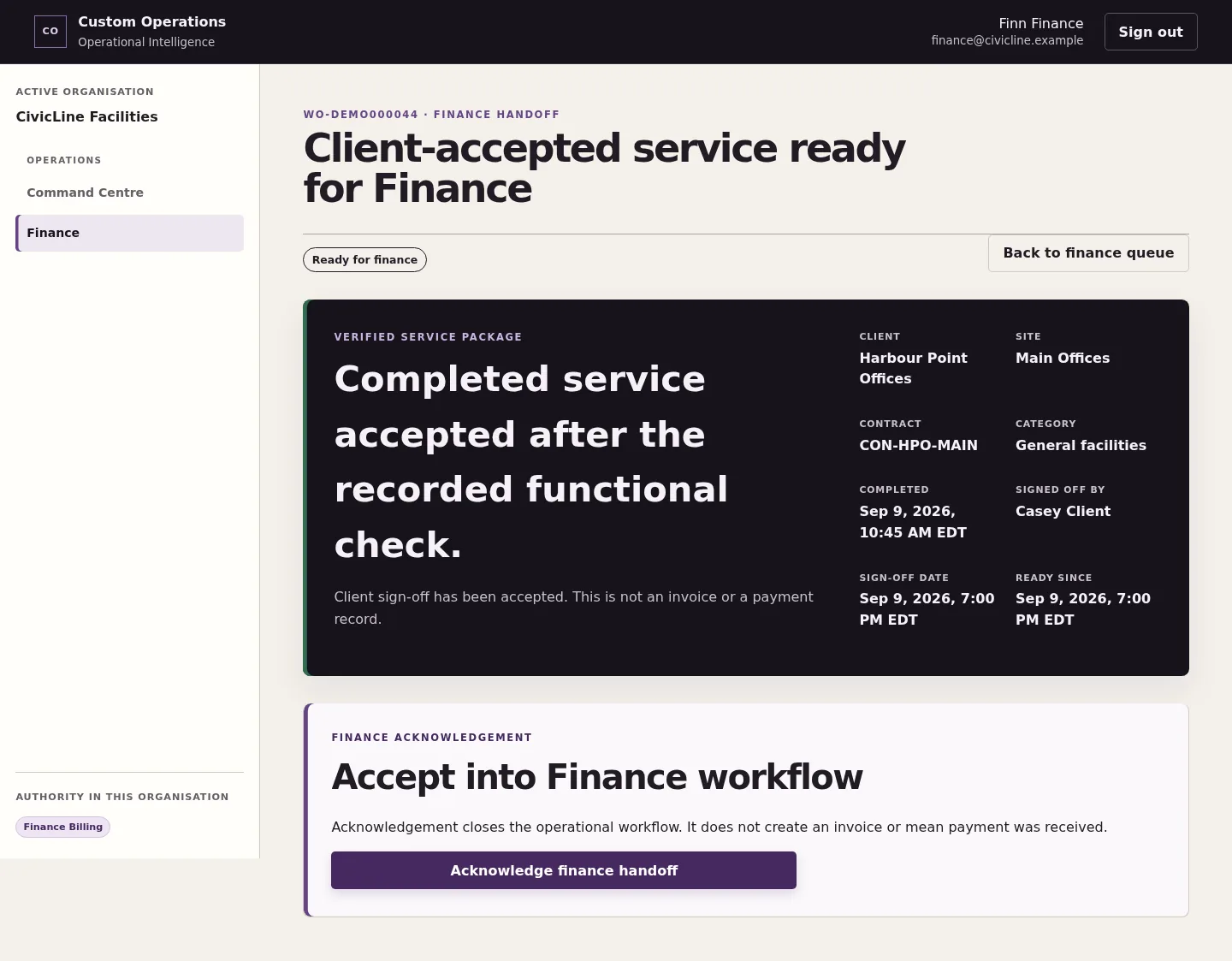
Finance handoff workspace with accepted service context and acknowledgement control
Finance handoffFinance receives accepted operational context. The screen does not represent an invoice, receivable, payment or accounting integration.
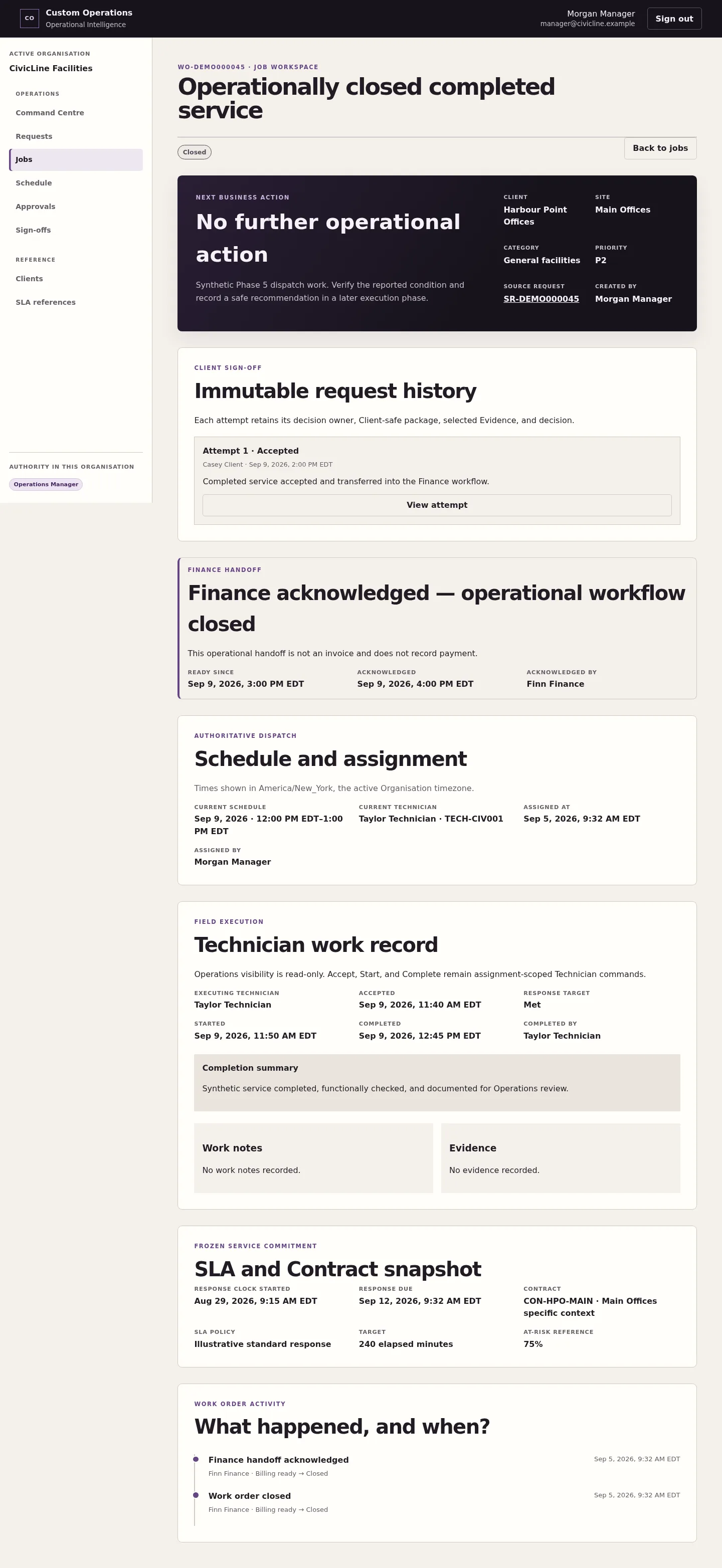
Closed Work Order audit record showing the terminal operational state
Terminal audit proofAcknowledgement completes the demonstrated operational loop and leaves a traceable terminal record.

Unit and integration

140 Vitest tests passed across 21 files.

Production browser

60 unique Playwright tests passed across desktop and mobile projects.

Accessibility checks

Representative axe, keyboard, focus, reduced-motion and 200% reflow checks passed.

Code quality

Lint, strict TypeScript and the production build passed.

Data layer

PostgreSQL 18.6 was healthy; Prisma validated and generated, all nine migrations were current, and repeatable seed verification passed.

Decisions and trade-offs

01

Service demand is not executable work

A Service Request can be incomplete, duplicated, cancelled or closed without work. Only controlled conversion creates a Work Order and freezes the applicable service context.

Trade-off: The extra record boundary adds triage steps, but prevents every message from becoming an operational commitment.

02

Approval does not silently resume the job

An exception blocks execution and creates a numbered, immutable approval attempt. A later decision records authority; a separate command deliberately resumes work.

Trade-off: The additional action avoids hidden state changes, but requires Operations to make resumed ownership explicit.

03

Finance receives a handoff, not fictional accounting

Accepted Client sign-off prepares verified service context for Finance. Finance acknowledgement closes the operational lifecycle without creating an invoice or payment claim.

Trade-off: The portfolio proves a clean boundary and stops before accounting, rather than simulating a larger product surface.

Implemented and verified

Service operations from demand intake through operational closure, including server-authoritative transitions, scoped interfaces and audit events.

Deliberately deferred

Invoicing, payment, GPS, routing, inventory, production object storage and malware controls, offline-native synchronization, workflow builders, AI and predictive analytics.

What this project demonstrates

Translating business-process analysis into distinct domain records, explicit state transitions, role-and-resource authority, responsive interfaces, transactional commands, private evidence, controlled decisions and a tested operational loop. The Command Centre surfaces attention from those records; it is not a claim of analytics, utilisation, prediction or measured performance.

Have a related business problem?

This record is transparent about its current evidence. Your project can begin with the problem you are trying to solve.